Actives
Hyaluronic acid
Sodium hyaluronate
It binds water — but the molecular sizes, and what goes on top, decide the result.
Hyaluronic acid is a substance the human body produces naturally. Its remarkable property is the ability to bind water and hold on to it. Well-hydrated skin is suppler, softer and smoother, and the fine lines caused by dehydration show less.
Speaking of hyaluronic acid as a single ingredient is too simple, though. What matters is the size of its molecules, because different molecular weights behave differently in the skin.
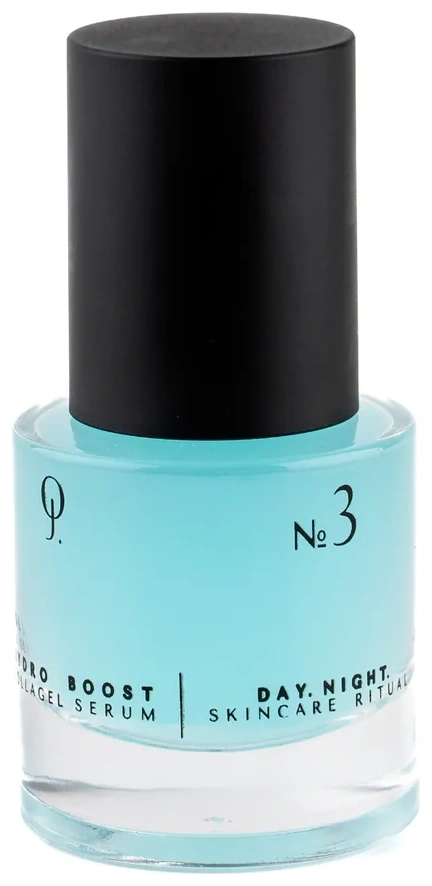
So the No3. Hydro Boost Collagel Serum does not use one type of hyaluronic acid but a molecular matrix of several sizes that complement one another within the formula.
Its smallest component is an ultra-low-molecular hyaluronic acid of only 3–5 kDa. Further molecular sizes join it, up to high-molecular hyaluronic acid, which works mainly at the surface, binding water and helping limit its loss.
3–5 kDa + further molecular sizes = a multi-level hyaluronic matrix.
The point is therefore not to use the “smallest possible” hyaluronic acid. The point is to combine molecular sizes so their properties complement one another — from immediate hydration and comfort at the surface to thorough hydration of the upper layers.
The result is skin that looks fuller, suppler, smoother and hydrated over time.
And that is the difference between hyaluronic acid as a line in the INCI list and hyaluronic acid as a considered part of the whole hydrating architecture of a formula.
- Role in the formula
- Hydrating ingredient
- Origin
- Produced by fermentation; the sodium salt of hyaluronic acid.