Cold-pressed oils
Prickly pear seed oil
Opuntia ficus indica seed oil
One of the most expensive plant oils in the world — for arithmetical, not marketing, reasons.
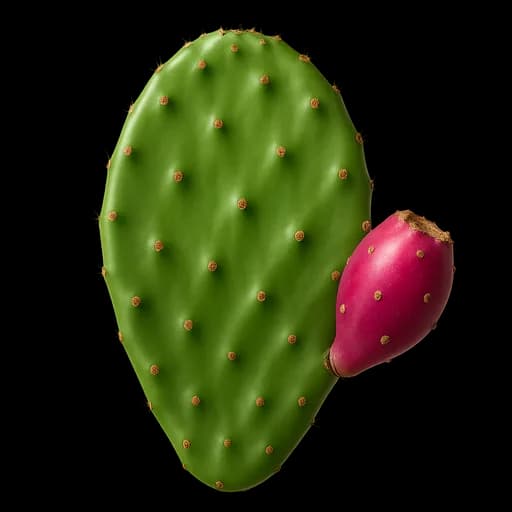
The prickly pear grows in the dry regions of the Mediterranean and Mexico. The oil is cold-pressed from the seeds of its fruit, and that is where the price comes from: the seeds are tiny, few per fruit and poor in oil. A single litre takes hundreds of kilograms of fruit, processed largely by hand.
By composition it belongs to the oils high in linoleic acid. That is an unsaturated fatty acid the skin itself uses in its lipid barrier, and oils rich in it tend to be light, absorb quickly and leave no greasy film. Prickly pear oil is one of them — silky to the touch, and then gone.
It also carries naturally occurring tocopherols, that is vitamin E, which helps it resist oxidation somewhat better than other linoleic oils. For an oil with so high a share of unsaturated acids that matters: without an antioxidant its life would be short.
The practical consequence of its lightness is where it fits. Heavy oils rich in oleic acid leave a pronounced film that suits some skin and troubles other. A light linoleic oil is the safer choice for skin that needs its lipids replenished but cannot carry a dense layer.
So prickly pear oil sits in both of our finishing No4. serums, day and night. In the day serum it keeps the morning layer light enough to wear under make-up; at night it counterweights the denser oils such as pequi. In both it is the ingredient that decides how the product feels to the touch.
- Role in the formula
- Softening and nourishment
- Origin
- Arid regions of the Mediterranean and Mexico; cold-pressed from the tiny seeds of the prickly pear fruit.
- Character
- A light, silky oil that absorbs without an oily film.

